
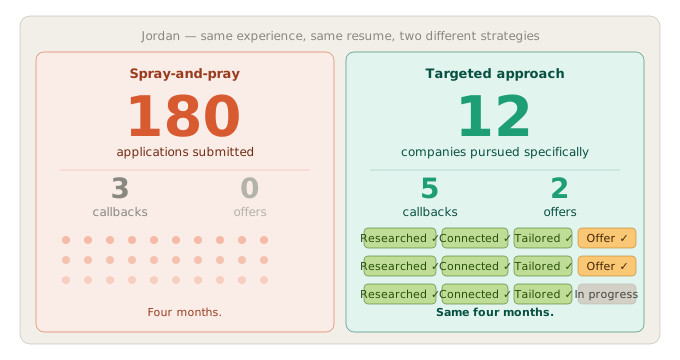
Jordan applied to 180 jobs over four months. Three callbacks. He did what most people do, tailored his resume, wrote cover letters, applied through LinkedIn and Indeed, and waited. The math didn't work.
Then he changed the approach. He picked 12 dream companies to pursue, researched each one, found connections, reached out before applying, and tailored every application to the role and the company. Five callbacks. Two offers.
Same experience. Same resume. Different strategy.
A targeted job search strategy isn't about applying less. It's about concentrating effort where it will actually convert. The conversion math is dramatically different: a referred, researched, tailored application is statistically far more likely to result in an interview than a generic one landing in the same pile as 300 others. The tradeoff is time, which means you have to be selective about where you spend it.
This article maps the sequence: how to choose your targets, research them properly, find a way in before applying, tailor your application, time your follow-ups, and be ready the moment they respond. It also covers something most guides skip, when to close a target that isn't moving and stop throwing energy at it.
If you're running a broader pipeline alongside your targeted efforts, a solid application tracking system is what keeps both from collapsing under their own weight.
Spray-and-Pray Is a Volume Problem, Not a Work-Ethic Problem
A targeted job search strategy means choosing a small number of specific companies, researching each one, finding your way in before applying, and tailoring everything to that company specifically. Three to five at a time. No more.
What makes it work is conversion math. The general-application route treats every posting as roughly equivalent: apply, wait, repeat. A targeted approach recognizes that some applications are worth ten times more effort because they have a dramatically higher probability of converting.
The data backs this up. Referral candidates convert to interviews at rates roughly four to five times higher than cold applicants, according to Jobvite's annual recruiting benchmark reports. Meanwhile, online applications have continued to increase in volume since 2022; LinkedIn Talent Solutions research shows cold applications are a harder path than they were three years ago, and the pile your resume lands in keeps getting bigger.
The tradeoff is real and worth naming upfront. Targeting five companies properly takes more time per application than sending 50 generic ones. You can't do both at full intensity simultaneously. Three to five targets at a time is the right number: enough options if one goes quiet, few enough that you can actually do the work.
How to Research a Company Before You Say a Word to Anyone
The research phase is what separates a targeted approach from a regular application. Most job seekers do a Glassdoor check and read the “About Us” page. That's table stakes, not research.
Useful research looks like this:
- Recent news and announcements. Funding rounds, new products, leadership changes, acquisitions. A company that just raised a Series B is in a different mode than one that announced layoffs last quarter. Both are useful to know before you reach out.
- Who was recently hired in your function. LinkedIn's “New Employees” filter shows who joined in the past 90 days. Three new PMs in two months is a signal. Zero PMs hired in a year is also a signal. Neither is definitive, but both tell you something.
- What problems the team is publicly working on. Job descriptions tell you about the role. Blog posts, conference talks, and podcast appearances tell you what the team is actually thinking about. If an engineering manager has spoken twice in six months about a specific problem, you know something real about their priorities.
- Who the hiring manager is. Not just the recruiter; the person who will actually make the hire. Knowing who that is before you contact anyone is basic preparation.
The goal isn't to drop references into a cover letter to show you did your homework. It's to actually understand the company's situation well enough that when you're in conversation with them, you can be genuinely useful.
The Three Tiers of “In” (And What Each One Actually Gets You)
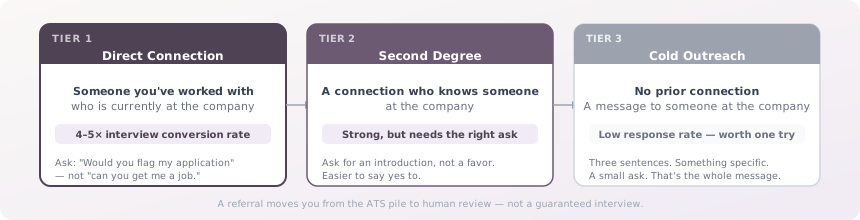
Most guides tell you to “leverage your network.” What they skip is the sequence, the realistic probability, and what to actually say. How you get noticed by an employer at a specific company, before you're even in the pile, comes down to which of these three paths you're on.
Tier 1: A direct connection. Someone you've worked with who is currently there. This is the strongest path. Ask if they'd be willing to flag your application when a relevant role is posted. Most companies have referral incentives, and even those that don't move referred candidates faster. A direct connection gets your resume in front of a hiring manager before HR ever sees it.
Tier 2: Second-degree outreach. A connection who knows someone at the company. The ask isn't “can you get me a job”, it's “would you be comfortable introducing me to [Name] for a short conversation?” An introduction request is easier to say yes to, and the relationship you build from there is what actually matters.
Tier 3: Cold outreach. A message to someone at the company with no prior connection. The response rate is low. It's still worth one thoughtful, specific attempt. One.
A note on what a referral actually does: it moves you from the ATS pile to human review. It does not guarantee an interview. It does not override a weak resume or a real mismatch. Being realistic about this matters, if you treat a referral as a golden ticket, you'll be disappointed, and you risk putting the connection in an awkward position.
Here's what a cold LinkedIn message that actually gets a response looks like: three sentences, something specific about their work or the company, and a low-ask close.
“I've been following your work on [specific thing]. I'm exploring opportunities in [function] and would love 15 minutes to understand how the team approaches [specific challenge]. Would you be open to a brief call?”
That's the whole message. No pitch. No resume attached. No “I think I'd be a great fit.”
Marcus had been interested in a fintech startup for over a year, not because he was job searching, but because he was genuinely curious about how they were approaching compliance tooling at scale. In January, he reached out to an engineering manager who'd given a conference talk he'd watched, mentioned a specific point from the talk, and asked for a coffee chat. They talked for 30 minutes about where the space was heading.
In March, the company posted a senior engineering role. The manager forwarded Marcus's resume to HR with a note. Marcus got a callback the same day the posting went live.
The outreach wasn't a tactic. It was a real conversation that happened to matter when the timing lined up.
Tailoring for a Specific Company Means More Than Keyword-Matching
Once you've done the research and worked the network, the application itself should reflect everything you've learned, not in a “I noticed on your website that...” way, but substantively.
Reshaping the narrative, not just inserting keywords. Which parts of your background genuinely connect to what this company is working on? If you've done the research, you know their priorities. Your resume should tell the story of someone who would be useful to this company specifically, not someone who generically fits a job description.
Keywords still matter as a floor, not a strategy. To check which of the posting's skills your resume already shows and which are missing, paste both into our free Resume Match tool; it runs in your browser and needs no account.
A cover letter has one job. Give one concrete reason why this company, not the role, the company, is worth writing to specifically. One thing you actually noticed in your research. One direct line between your background and their current challenge. Three sentences. That's all it takes to be clearly different from the pile of letters that are all interchangeable.
One more thing about the resume you tailor. Once you've submitted it, save a copy somewhere you can actually find it. You've invested real time in the specific choices you made, what you led with, what you cut, what angle you took. When a recruiter calls three weeks later, you'll want to pull it up in two minutes. Keeping your resume versions organized and tied to specific applications matters more as the search gets longer.
Timing Your Application and Follow-Ups
Sequence matters more than most job seekers realize.
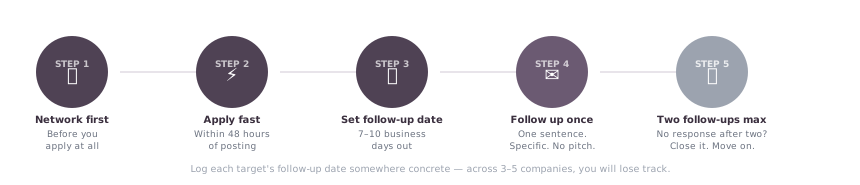
- Network first, apply second. If you have a connection at the company, reach out before you submit. Ask them to flag your application, not to advocate for your hire. That's a smaller ask, and it moves your resume from the pile to the shortlist.
- Apply within 48 hours of the posting going live. Applications in the first day or two have meaningfully better review rates. After the first week, companies with active pipelines may have already begun shortlisting. This is especially true at smaller organizations where hiring timelines move fast.
- Set a follow-up date at 7–10 business days from submission. If you have a contact, send a short, specific note, one sentence affirming your interest, one sentence about why this company specifically. If you don't, log the date and wait.
- If a recruiter gives you an explicit timeline, follow up one business day after that date passes. They set the expectation; holding them to it is reasonable.
- Two follow-ups is the limit. If there's been no response after two thoughtful attempts, close it. A third follow-up doesn't move the needle with a company that's engaged, and it occasionally turns off one that was about to respond.
The follow-up date for each company is worth logging somewhere concrete. Across three to five targets, you will lose track of where each one stands if you're keeping it in your head.
Being Ready When They Actually Call
This is the section nobody writes. Every guide covers how to get noticed. None cover what happens when it works.
You've spent three weeks on this company. You researched their team, reached out to two connections, had one informational call, tailored your resume specifically to their growth stage, and wrote a cover letter that actually said something real. The recruiter emails on a Tuesday afternoon. They want to schedule an intro call Thursday morning.
Do you know exactly which version of your resume you submitted? Not the general “product manager resume”, the specific version you tailored, with the specific angle you chose to lead with. Do you know what you said in the LinkedIn message to the engineering manager? What came up in the call with the team lead?
Kira had spent a month carefully building up to a referral at her top target. She'd had a 20-minute informational call with a team lead, gotten a connection to flag her application, and tailored her resume specifically to their tech stack and stage.
The recruiter called on a Wednesday. One of the first questions was about a project Kira had mentioned in her informational call, not on her resume. She remembered the conversation, but not the detail they were referencing. She'd taken notes, somewhere. She wasn't sure where.
She answered. But not with the confidence she'd spent weeks building toward.
On a targeted search, the organizational piece is load-bearing. You're not tracking one application, you're tracking a series of touchpoints at each company over weeks: the outreach message, what came up in the informational call, what angle you took in the cover letter, the follow-up you sent and when. By the time a recruiter calls, that context is four weeks old and scattered across your inbox, a notes app, and memory.
This is where a job application tracker earns its place, not as a filing system, but as a briefing document you can open ten minutes before the call. Log the application, attach the resume, note what came up in the informational call, record who you spoke with and what they mentioned. When the recruiter calls, you're not reconstructing, you're reviewing. See how Vitae keeps your applications and their full context in one place.
Knowing When to Close a Target (And Why That's Not Giving Up)
Most guides end at “follow up.” This one doesn't, because knowing when to stop is harder than most people admit, and harder the more you've invested.
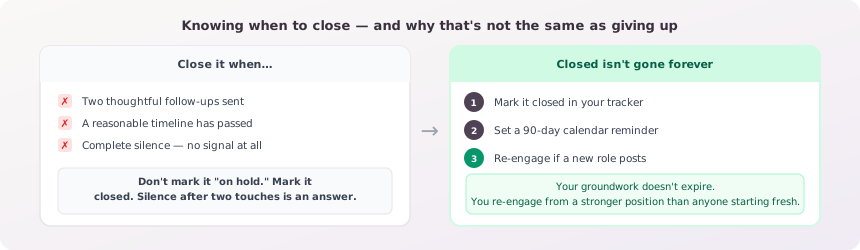
The practical rule: if there has been no response after two thoughtful follow-ups and a reasonable timeline, close it. Not “on hold.” Closed. A company that's engaged gives you a signal. Complete silence after two touches is an answer.
The emotional difficulty is real. You've spent weeks on this company. Closing it feels like giving up. It isn't. It's making an honest assessment and putting that energy toward targets that still have signals.
One thing worth doing: mark it closed in your tracker and set a 90-day calendar reminder. If a new role is posted, your groundwork doesn't expire. The relationship you built, the context you developed, the understanding of their team, you can re-engage from a stronger position than anyone starting fresh.
A Targeted Job Search Strategy Takes More Work: That's the Point
A targeted job search strategy converts better because it treats each company as a relationship, not a transaction. Most job seekers submit and hope. A targeted approach means you research, connect, tailor, and are genuinely ready the moment you hear back.
The tradeoff is real. You can't run a full targeted search and a high-volume search simultaneously, not well. The targeted approach only works if you're genuinely selective: three to five companies at a time, chosen because the fit is real and the timing makes sense, with the honest acknowledgment that some will go nowhere despite your best effort.
If you're managing a broader pipeline alongside your targeted companies, the same organizational system that keeps your full search from collapsing is what makes your targeted applications work. The tracker that knows what you sent, who you spoke with, and what's due next, that's what makes you ready when anyone calls. Not just your top targets.
Vitae is a job application tracker with resume version snapshots built in. Log your targeted applications, see exactly what you submitted for each one, and track your outreach alongside your pipeline. The free tier gets you started, Premium unlocks up to 200 applications starting at $12/month if you're running a serious search.
Start tracking freeNo credit card required.