
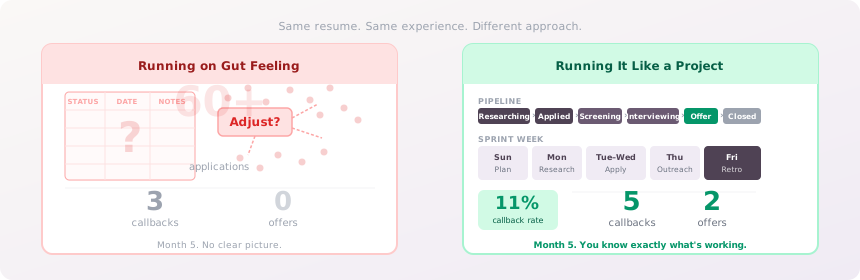
You're in month two. You have 40-something applications out, a tracker that made sense when you started, and a growing suspicion that the approach isn't quite working, but you can't put your finger on why. You adjust based on how the week felt. You apply more when you're anxious and less when you're discouraged. Nothing's actually telling you what's broken.
The average job search runs five to six months. That's not a sprint you can manage on good intentions and a rough plan. It's a project, and projects that run five months without a system tend to drift.
Most job seekers don't treat it that way. They apply as opportunities appear, track status in a spreadsheet that gets harder to read as it grows, follow up inconsistently, and adjust based on gut feeling rather than numbers. Six months of effort, and the most useful question, “is what I'm doing actually working?”, is genuinely hard to answer.
Project managers build systems for exactly this kind of sustained, multi-variable effort. The good news: you don't need a PMP certification to use them. This article walks through how to organize your job search using six of those concepts, scope, pipeline, sprints, metrics, retrospectives, and knowing when to close something, translated into job-seeker language.
Your Job Search Is Already a Project. You're Just Not Running It Like One.
A project, in the PM sense, has a few defining characteristics: it has a defined scope, a pipeline of work in progress, a timeline with milestones, and a feedback loop that lets you adjust based on what's working.
A job search has all of these things. It just usually lacks the structure that makes them visible.
The Bureau of Labor Statistics consistently finds job searches averaging five to six months for unemployed workers, longer for career transitions and senior roles. Over that span, the math compounds: the average job seeker submits roughly 62 applications, spends around 46 hours on those applications, and receives callbacks from about 8.3% of them. If you're below that callback rate and you don't know it, you can't fix it.
Alex was two months in and applying hard. By the time he hit 38 applications, across four industries, three seniority levels, two cities, his tracker had a row for all of them and a status column that was mostly “Applied,” “In Progress,” and blank cells. When a recruiter called in month three about a role he'd applied to in week one, he couldn't find the row. He spent twelve minutes on hold trying to reconstruct the application before admitting he didn't remember the details.
The problem wasn't Alex's effort. It was that he was running a project without project management.
The goal of organizing your job search like a project manager isn't to make the process more bureaucratic. It's to build a system that's honest about where things stand, surfaces the problems you'd otherwise miss, and helps you learn as you go.
Step 1: Define Your Scope Before You Apply Anywhere
In project management, scope definition is the first deliverable: what does this project include, and what does it explicitly not include? Both matter.
For a job search, scope covers the roles you're targeting, function, level, industry, plus geography or remote requirements and a compensation floor. Most job seekers define this loosely in their head and adjust it constantly based on what appears in their feed that day.
That's scope creep, the gradual expansion of a project past its original boundaries, usually through individual decisions that each seem reasonable in the moment but collectively cause the effort to sprawl.
Write down your scope statement before you apply to anything. It doesn't need to be long:
“Senior product manager roles, B2B SaaS, remote-first or San Francisco, base salary $150K+. I am not applying to: early-stage startups pre-Series A, roles with more than 30% of comp in equity, or roles that require 50%+ travel.”
The exclusions matter as much as the inclusions. Every time you're about to apply to something outside your scope, the statement forces you to make a conscious decision rather than a reflex one. Over a five-month search, that discipline compounds.

Step 2: Build a Pipeline, Not a List
A list tracks what you've done. A pipeline tracks where things are moving.
The difference matters at the six-week mark, when you have 40-plus applications and no clear sense of which ones are actually alive. A list tells you what you applied to. A pipeline tells you what's in play, what needs action, and what's quietly dead.
Here's a pipeline structure that works for most searches:
| Stage | What It Means |
|---|---|
| Researching | A company on your target list that you haven't applied to yet |
| Applied | Submitted, waiting for first response |
| Screening | Phone or video screen scheduled or completed |
| Interviewing | In process, one or more interviews underway |
| Offer | Offer received, evaluating |
| Closed | No further action, rejected, withdrawn, or went quiet |
The most important discipline: set a work-in-progress limit on your Applied stage. Don't let Applied grow past five to eight applications you're actively following up on. Beyond that, you can't do the follow-up work properly, and the stage becomes a graveyard that inflates your sense of how much is actually in play.
If you're applying faster than you're following up, that's a signal. Either the follow-up stage needs more effort, or the application pace is too high to maintain quality.
Step 3: Work in Weekly Sprints
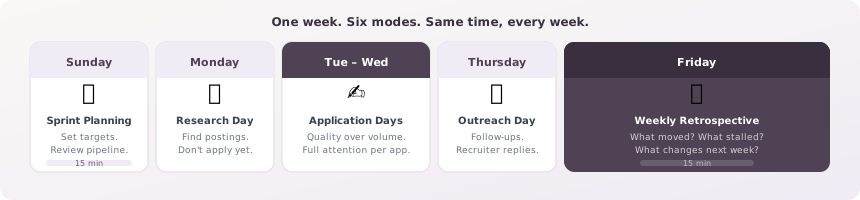
A sprint is just a week with a plan at the start and a review at the end. For a job search, that structure looks like this:
Sunday evening (15 minutes): Plan the week. What are your targets? Which pipeline stages need attention? How many applications are you aiming for?
Monday: Research day. Review your target company list. Find new postings that match your scope. Don't apply yet, just identify and add to Researching.
Tuesday and Wednesday: Application days. Work from your Researching stage. Write and send applications with your full attention on quality, not volume.
Thursday: Outreach day. Follow up on applications past the seven-day mark. Reach out to connections at target companies. Respond to recruiters promptly.
Friday: Review and retrospective (see Step 5).
This structure isn't rigid, interviews happen when companies schedule them, and some weeks are heavier than others. But batching similar work by day reduces the cognitive cost of switching between researching, writing, and following up, all of which require different mental modes.
If you're running a targeted search alongside a broader pipeline, the sequence for pursuing specific companies runs on a slightly longer timeline: networking first, application second, with more time per company before moving forward.
Step 4: Track the Metrics That Actually Tell You Something
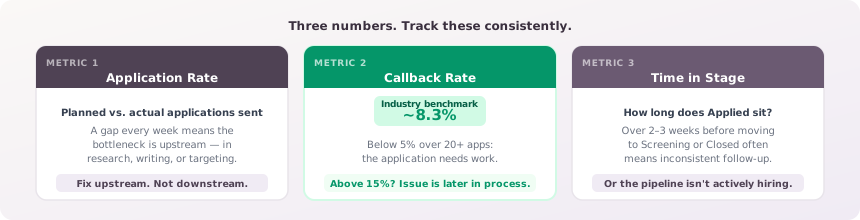
Three numbers are worth tracking consistently:
Application rate. How many applications per week are you actually sending? Not your target, your actual rate. If there's a persistent gap between plan and reality, the bottleneck is earlier in the process (identification, research, or writing) rather than response rates. Fix upstream, not downstream.
Callback rate. The percentage of applications that result in any recruiter contact. The rough industry benchmark is 8.3%, meaning about one callback for every 12 applications. If you're below 5% over 20-plus applications, something about the application itself needs to change. If you're above 15%, the resume is working and the issue may be later in the process, screening, interviewing, or fit.
Time in stage. How long does anything sit in Applied before moving to Screening or Closed? A long average, more than two to three weeks, often means you're not following up consistently, or applications are going into pipelines that aren't actively hiring.
The callback rate analysis becomes significantly more useful when you track which resume version you submitted for each application. If one version is generating callbacks at 14% and another at 3% across similar roles, that's not random. Tracking which resume version you sent to each application is what makes this kind of analysis reliable. Without frozen version records, the data is too soft to act on.
Step 5: Hold a Weekly Retrospective
The retrospective is the fifteen minutes on Friday where you ask three questions before you plan next week:
- What moved this week? Which applications advanced stages? Which conversations happened? What specifically contributed to movement?
- What stalled? What stayed stuck? What didn't happen that you intended, and why?
- What am I changing next week? Based on 1 and 2, what's one specific adjustment?
This is where the search gets smarter. Without it, most job seekers iterate on gut feeling: “this week felt better” or “I don't know, nothing's working.” With it, they iterate on data.
Priya was three weeks into her search with three applications out and zero responses. Her Friday retrospective showed something she hadn't noticed: all three applications were at large enterprise companies with 60-day posting cycles. She'd been applying to companies where the hiring process was simply slow, not broken, just slow. The fix wasn't to change her resume. It was to add mid-size companies with faster timelines to her pipeline so she'd have earlier signals while the enterprise processes ran their course.
She wouldn't have seen that from inside the week. The retrospective made it visible.
Fifteen minutes, same time every Friday. That's the entire commitment. The compounding effect over a five-month search is real: fifty retrospectives, fifty chances to make a small adjustment before the wrong approach runs for another week.
Step 6: Close Stale Applications Honestly
The hardest part of the pipeline isn't building it. It's keeping it honest.
Most trackers accumulate dead weight: rows marked Applied or In Progress that have had no signal in weeks, kept open on hope rather than evidence. A graveyard pipeline is more demoralizing than an accurate one. It makes the search feel larger and more active than it is, which makes the silence feel worse.
The rule: if two thoughtful follow-ups have gone unanswered after a reasonable timeline, move it to Closed. Not “on hold.” Closed.
This feels like admitting defeat. It isn't. Closing an application is a data point, not a judgment. It tells you that particular company, at that particular moment, wasn't a match, and it frees the mental space that “I should probably follow up on that” was quietly consuming every day.
Closed doesn't mean permanently over. Set a 90-day calendar reminder. If the company posts a new role that fits your scope, you re-engage from a position of existing context. You've researched the company, you may have made connections there, you understand what they're working on. That's a stronger starting position than someone coming in cold.
The goal of the pipeline is a list where every row represents something you genuinely expect to hear from. Anything else is noise.
Putting It Together
Organizing your job search like a project manager means building a system that's honest about where things stand and structured enough to learn from.
The pieces connect, and the connection is what makes each one worth doing. Scope without a pipeline is just a wishlist. Metrics without a retrospective are just numbers. A retrospective without honest closes is just a weekly disappointment.
Job searches are genuinely hard, and a well-organized hard thing is still hard. What changes is that the effort becomes traceable, and traceable effort is improvable effort.
Vitae keeps your applications, resume snapshots, and pipeline stages in one place, so when your retrospective asks “which resume version is getting callbacks?” you can actually answer it. See how the pipeline tracking works before committing to anything.
Vitae is free to start. Log your first applications, run your first sprint, and see whether having a real system changes how the search feels.
Create a free accountNo credit card required.