
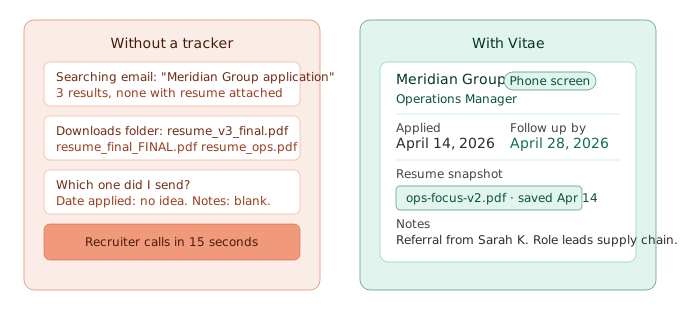
A recruiter calls from a company you applied to six weeks ago. You're excited, but then comes the scramble: which role was this exactly, which resume did you send, was it the one tailored for operations or the one that led with the project management work? You have about fifteen seconds before the conversation starts.
Most job seekers know they should follow up on job applications. The questions are always the same: when is it too soon, when is it too late, and what do you actually say? This guide covers the timing by scenario, a real template you can use, and the one thing almost no follow-up article mentions: what you need ready before you write a single word.
If your application records aren't organized, every follow-up is harder than it needs to be. See how Vitae keeps your application details in one place.
When to Follow Up on a Job Application
Timing depends on what the posting told you. Three scenarios cover most situations.
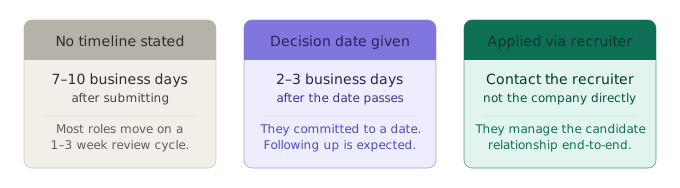
If no timeline was stated: Wait 7 to 10 business days from the date you submitted. Most active roles move on a one-to-three-week cycle from when applications close to when outreach begins. Following up before a week has passed reads as impatient. Waiting beyond three weeks means you've likely missed the active review window.
If the posting listed a decision date: Wait until 2 to 3 business days after that date has passed. “We'll be in touch by [date]” is a commitment from the hiring team. If the date passes with no word, a follow-up is appropriate and expected. You're not being pushy; you're taking them at their word.
If you applied through a recruiter: Contact the recruiter, not the company directly. They're managing the candidate relationship and will route your follow-up appropriately. Going around them creates friction.
Only about 8% of job applications generate a recruiter response, according to employer outreach data from employers.io. That rate makes it easy to assume silence means rejection. It often just means you haven't been reviewed yet.
The timing question resolves to one rule: give the team enough time to complete an internal review cycle, then check in once before moving on.
What to Have Ready Before You Write It
This is the section most follow-up guides skip. The email itself isn't the hard part. The hard part is writing a specific, confident follow-up when you've applied to 50 companies over 12 weeks and can't reliably recall the details of each one.
Before you write anything, pull together:
- The exact job title (copy it from the original posting if you saved it)
- The date you submitted your application
- The hiring manager's name, if it appeared in the posting or on LinkedIn
- Which version of your resume you submitted, and what it emphasized
- Any specific detail from the posting worth referencing: a project, a stated priority, a skill they specifically called out
That last point matters more than people realize. A follow-up that references something specific from the role sounds like it came from someone paying attention. A follow-up that says “I remain very interested in this exciting opportunity” sounds like a template, because it is one.
If you're tracking your job applications carefully, all of this should be a two-minute lookup. If you're working from a loosely maintained spreadsheet or reconstructing details from your email history, this is when organizational gaps become visible.
Resume version control becomes especially relevant here. Knowing which version you submitted, and what that version said, is what lets you reference your own application coherently. If your tracker doesn't capture that, you're guessing.
Nadia was three months into her search when a company she'd almost forgotten called to schedule a first-round interview. She had around 65 active applications tracked in a Google Sheet. When she went to pull up the details before the call, the resume column said “updated version” with no file attached and the date column was blank.
The interview went reasonably well, but she spent the opening minutes uncertain whether she'd sent the resume that led with the product experience or the one that emphasized operations. The prep that should have taken five minutes took thirty, and she still wasn't confident she'd gotten it right.
How to Write a Follow-Up Email (With a Template)
Keep it short. Three to four sentences is right. Anything longer signals anxiety, not enthusiasm.
Email is almost always the correct channel. Phone follow-ups rarely work unless the posting specifically invited a call. Even then, an email gives the hiring team time to check their notes before responding. Voicemails often go unreturned.
Here's a job application follow-up email template that works:
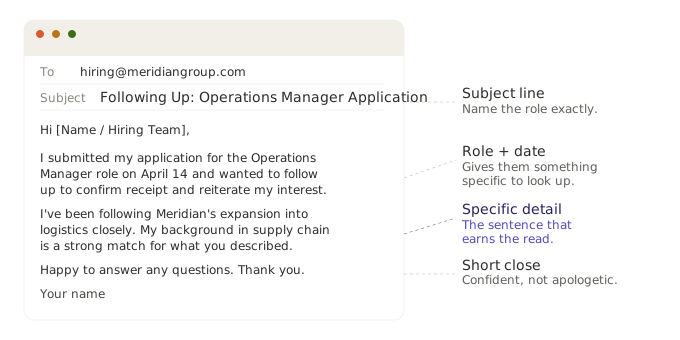
Subject: Following Up: [Job Title] Application
Hi [Name / Hiring Team],
I submitted my application for the [Job Title] role on [date] and wanted to follow up to confirm it was received and reiterate my interest. I've been following [something specific to the company or role] closely and believe my background in [relevant area] is a strong match for what you've described.
I'm happy to answer any questions or provide additional materials. Thank you for your time.
[Your name]
What makes this work:
- It names the role by title, not “a position I applied for”
- It includes the date you submitted, which gives them something specific to locate
- The specific detail in the second sentence is where the email earns the read. Skip that line if you can't make it genuinely specific.
- The close is confident without being aggressive
What to avoid: Don't open with “I just wanted to check in” or “I know you're very busy.” Both read as apologies for reaching out on something you're fully entitled to follow up on. Don't ask why you haven't heard back. Don't push for a decision date. The email should be short enough that they can read and respond in under a minute.
How Many Times Should You Follow Up?
Once. In almost every situation, one follow-up is the right answer.
If they respond and say they're still reviewing: thank them, confirm your continued interest, and leave it there. You've done your part.
If they don't respond to your follow-up: let it go. A second email to silence reads as pressure, not persistence, and it rarely changes the outcome. If the role is still actively posted after two to three more weeks with nothing, one additional brief check-in is defensible. That's the ceiling.
Marcus applied to a growth-stage company in April. He sent his first follow-up after ten business days with no response, then a second two weeks later, then a third. By the time the hiring manager was ready to schedule interviews in late May, Marcus had appeared in their queue four separate times. The team moved to the next candidate rather than deal with the volume. Marcus was qualified. The over-following-up cost him more than the competition did.
One follow-up is professionalism. Two is persistence. Three is pressure. The distinction matters.
Tracking Follow-Ups Across Multiple Applications
The hardest part of following up isn't writing the email. It's knowing which of your active applications are due for a follow-up and when.
At 20 to 25 applications, a spreadsheet column is workable. At 60 to 80 applications (realistic if you're four or five months into an active search) that column is not enough.
The Bureau of Labor Statistics puts the average job search at five to six months for unemployed workers. At ten to fifteen applications per week, that's several hundred applications over the course of a full search. Dates slip. Rows go blank. Applications fall through without a follow-up ever sent.
If you're noticing signs that your job search system isn't holding up, follow-up tracking is usually one of the first things to break down.
A few approaches that hold up at scale:
- Calendar reminders tied to each application (functional, but clutters the calendar fast at volume)
- A spreadsheet with a dedicated “follow up by” date column reviewed each morning (works if the discipline holds, which it often doesn't past week six)
- A dedicated tracker that includes follow-up dates as part of the application record and surfaces them automatically
Vitae includes a follow-up date field in each application card. When you log an application, you set the date and it shows up in your tracker when it arrives. No separate reminder to create, no calendar event to manage. The date is part of the record, tied to the application it belongs to.
If you want a fuller system for staying organized across a months-long search, How to Organize Your Job Search Like a Project Manager covers the full setup.
The timing is straightforward. The template is short. What makes each one work is having the details ready when you need them: the role, the date, the resume version you actually submitted. When the recruiter calls and the conversation starts before you've had time to search your Downloads folder, that preparation is what the follow-up was always building toward.
Ready to stop reconstructing application details from memory?
Vitae tracks your submissions, resume snapshots, and follow-up dates in one place. Free to start, no credit card required.
Create a free account