
It's Thursday afternoon. Your laptop is open. You've had the same two tabs open since this morning, a job board and a cover letter draft you haven't touched, and you haven't typed a word in two hours.
This isn't procrastination. You're not lazy. You're experiencing job search burnout, and it's a rational response to a system that was never designed to be easy.
According to a 2023 survey by Insight Global, 55% of unemployed adults say they're completely burned out from the job hunt. A separate Glassdoor poll found that 53% have paused their search entirely to protect their mental health. These aren't people who gave up. They're people who hit a wall that was always going to be there.
This article won't promise a system that makes burnout disappear. What it will do is help you figure out which kind you're dealing with, because not all burnout is the same, and treating the wrong type doesn't help, and give you concrete moves for each.
What Job Search Burnout Actually Is
Job search burnout is physical and emotional exhaustion from the sustained demands of looking for work: the applications, the silence, the rejections, the uncertainty. Unlike a rough week, it doesn't resolve when something goes right.
The enthusiasm doesn't come back. The applications don't get written. The inbox stays closed.
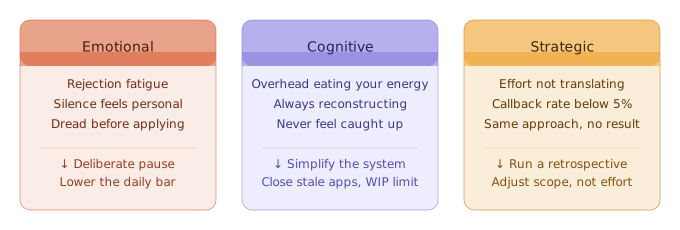
There are three distinct types of job hunting burnout, and they have different causes and different fixes.
Emotional burnout comes from rejection fatigue, the cumulative weight of silence, ghosting, and nos. It hits hardest for people who are taking the search personally. Most people do, despite the advice not to.
Cognitive burnout comes from the overhead of managing the process itself. Not knowing what you've applied to, which resume you sent, what's still in play, the mental maintenance of a disorganized search adds friction to everything, and that friction compounds quickly. If your tracker is making the search harder rather than easier, that's part of the problem.
Strategic burnout comes from doing the right things with the wrong approach. You're applying, following up, tailoring, and getting nothing back. The effort is real but the method isn't working, and the gap between input and output is demoralizing in a specific way.
Why the Job Search Is Uniquely Brutalizing
You apply and hear nothing. You interview well and still don't get the call. You tailor a resume carefully and the application disappears into a portal that never acknowledges receipt.
Most high-effort activities give you feedback. You practice, you improve, you see results. The job search doesn't work this way.
The Bureau of Labor Statistics consistently finds job searches averaging five to six months for unemployed workers, longer for career transitions and senior roles. In a five-month search with no consistent feedback, the absence of signal feels like rejection even when it isn't.
The structural problem is that the job search operates on a variable reward schedule. Effort doesn't predict results consistently. You can do everything right and still get nothing back. That randomness, sustained for months, is exactly how job search fatigue sets in, and how you end up staring at an open tab for two hours without writing a word.
72% of job seekers report that hunting for work has negatively affected their mental health. Job seeker burnout is the default experience, not the exception. That's not a personal failing. It's the design of the system.
The Cognitive Load Nobody Talks About
Here's where burnout gets more specific: a significant part of what people experience as emotional exhaustion is actually cognitive overhead.
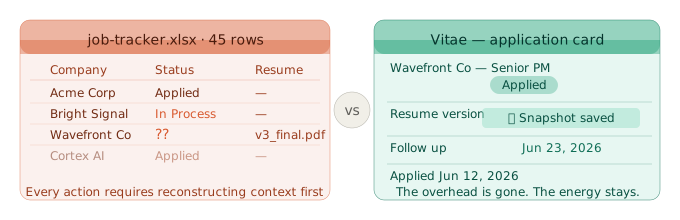
When your search is disorganized, 40 applications out, can't remember which ones, status column full of “Applied” and blank cells, resume versions scattered across folders, every action requires reconstructing context first. Before you can follow up, you need to figure out what you applied to and when. Before you can tailor the next resume, you need to find which version is current. Before you can answer a recruiter's question, you need to remember what you submitted.
That reconstruction overhead compounds the emotional difficulty. You're not just tired of rejection. You're tired of not knowing where you stand.
Marcus was in month three of his search, applying steadily and keeping a spreadsheet. By the time he had 45 rows, the spreadsheet had become its own problem. Status columns were inconsistent, “Applied,” “In Process,” “??”, and the resume column was mostly blank.
When a recruiter called about a role he'd submitted six weeks earlier, Marcus spent nine minutes on hold trying to pull up the job description before admitting he couldn't find it. The call ended without a next step.
Marcus wasn't just experiencing rejection fatigue. He was carrying the cognitive weight of a system that generated more overhead than it removed. That overhead was draining the energy he needed for the search itself.
Organizational chaos amplifies burnout. Reducing it won't cure the emotional difficulty of job searching in a hard market, but it does eliminate a layer that's optional. Fixing your tracking system is one of the few interventions that actually reduces cognitive burnout rather than just managing the symptoms.
How to Diagnose Your Burnout Before You Treat It
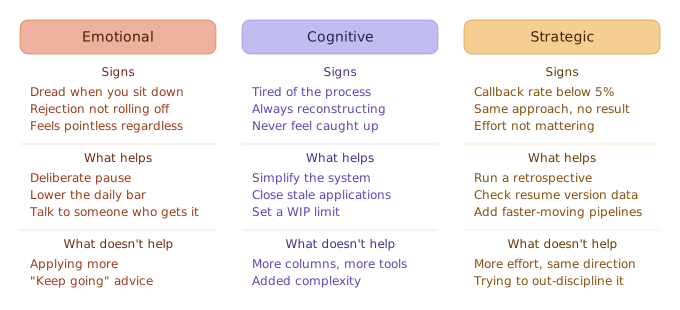
The most effective way to overcome job search burnout is matching the fix to the type. Treating cognitive burnout with a vacation doesn't work. Treating strategic burnout with self-care doesn't work, and both waste energy you don't have.
Emotional Burnout
Signs: You feel okay when you're rested, but the moment you sit down to apply, dread comes back. Rejection isn't rolling off, you're replaying interviews, second-guessing responses, feeling personally judged by silence. The process feels pointless even on weeks when you're doing it right.
What helps: A deliberate pause, more on this below. Lower the daily bar temporarily: one application, one follow-up, or one company researched is enough when you're depleted. A conversation with someone who understands what the search actually feels like. The goal is to make the thing feel less existential before you make it feel productive again.
What doesn't help: Applying more. “Keep going” advice that doesn't acknowledge what you're actually experiencing. Trying to out-discipline the problem.
Cognitive Burnout
Signs: You're tired of managing the process more than you're tired of the outcome. You always feel behind, always reconstructing where things stand. The overhead of keeping track is eating the energy you'd need for the actual work.
What helps: Simplifying the system. Closing stale applications honestly, a row in your tracker that hasn't moved in three weeks isn't active, it's noise, and keeping it open costs something every time you look at it. Setting a work-in-progress limit on the applications you're actively following up on. Reducing the cognitive maintenance required so your energy goes to the search, not to managing the chaos.
What doesn't help: More complexity. More columns in the spreadsheet. Adding another tool before you've simplified what you already have.
Strategic Burnout
Signs: You're putting in the work and getting nothing back at rates that suggest something structural is off. Callback rate is consistently below 5% across 25 or more applications. You've been applying to the same type of role at the same type of company for months with consistent non-response. The exhaustion comes from the effort not mattering, not from the effort itself.
What helps: A retrospective that looks at what's actually been happening. If you're tracking which resume version you submitted to each application, that data is often where the answer lives, one version generating callbacks at a meaningfully higher rate than another is a signal, not noise. A scope reset: tightening the target list and adjusting company type or stage, adding faster-moving pipelines to get earlier feedback while slower ones run. The fix is usually a targeting adjustment, not more effort in the same direction.
What doesn't help: More of the same. Trying harder at an approach that the data is already telling you isn't working.
The Permission to Stop (And How to Use It Well)
A deliberate pause and an accidental one are not the same thing.
An accidental pause is when you stop applying because you can't make yourself do it, the days blur together, and two weeks later you realize you haven't done anything. That pause compounds the burnout, you feel guilty for stopping, which makes starting harder, which extends the pause.
A deliberate pause is a decision: “I'm taking three days off from the search. Starting Wednesday.” You name the length. You tell someone. You plan what you'll do instead.
Three days of actually not doing it, not scrolling job boards “just to check,” not reviewing your LinkedIn profile, not drafting follow-ups in your head. Fully off.
When you come back, you don't come back at full intensity. You come back at one action per day: one application, one follow-up, one company researched. The sprint structure can wait another week. What matters is re-establishing momentum without immediately burning it back out.
Rest that actually works requires actually stopping. Half-resting while monitoring your inbox isn't rest. It's anxiety with better optics.
Structural Changes That Reduce Ongoing Burnout
Emotional recovery gets you back in the search. Structural changes keep burnout from immediately returning.
Set a work-in-progress limit. Don't apply to more roles than you can meaningfully follow up on. Five to eight active applications at once is a manageable number for most people. Beyond that, the Applied stage becomes a graveyard, roles you applied to but can't actually follow through on, which generates more cognitive overhead and more silence, both of which feed burnout.
Close stale applications honestly. If two follow-ups have gone unanswered after a reasonable timeline, move it to Closed. Not “on hold.” Closed.
The graveyard pipeline, rows you're keeping open on hope rather than evidence, is demoralizing in a quiet, persistent way. Every time you open your tracker and see that row, it costs something. Closing it returns that mental space.
Run a weekly retrospective. Fifteen minutes on Friday. Three questions: What moved this week? What stalled? What's one specific thing I'm changing next week? This is how the search gets smarter instead of just harder.
Dani was exhausted by month three. She'd been applying steadily, three or four applications a week, consistent follow-ups, tailored resumes, and the callback rate wasn't improving. Her first Friday retrospective showed her something she hadn't noticed from inside the weeks: every company she'd applied to in the past month had Glassdoor reviews mentioning a “lengthy hiring process.” She'd been applying exclusively to companies with 90-day timelines and interpreting the silence as failure.
The fix wasn't to reconsider her qualifications or apply harder. It was to add mid-size companies with faster hiring timelines to her pipeline so she'd have earlier signals while the longer processes ran their course.
The burnout didn't disappear, job searching is still genuinely hard. But the question shifted from “what's wrong with me?” to “what's wrong with my targeting?” That's a more solvable problem.
For the full framework, scope definition, pipeline stages, sprint structure, metrics, and retrospectives, how to organize your job search like a project manager is worth the read before you start the next sprint.
Putting It Together
Job search burnout doesn't mean you're failing. It means the process is hard, and the process is genuinely hard, in ways that no amount of enthusiasm or structure fully addresses.
Ghosting is structural. Randomized feedback is structural. Uncertainty is structural. Those things aren't going away.
What you can address is the layer on top: the cognitive overhead of a disorganized search, the strategic mismatch between effort and approach, and the absence of a recovery rhythm that gives you permission to stop without letting it become a spiral.
Vitae keeps your applications, resume snapshots, and pipeline in one place — so the organizational overhead stays low and your energy goes to the search, not to managing the chaos of it. Free to start, no credit card required. Create a free account when you're ready to run the next sprint with less overhead, or see how the pipeline tracking works first.
Create a free account